

Most people think of glare as a summer problem. It is not. From November to March the sun sits low enough to shine straight through your windows and across the room, and the snow outside throws a second dose of light back up through the same glass. Your eaves, built to block the high summer sun, do nothing at all.
That is the winter glare trap. Here is how it works and what to do about it.
The short version:
- The winter sun reaches about six times deeper into a room than the summer sun, onto floors and furniture that never see sun in July.
- Snow reflects up to 80 per cent of UV. A lawn or a lake reflects under 10.
- Cold, sunny mornings are the hardest days of the year on your glass. That is when thermal cracks and tired seals happen.
- You can keep the winter light and lose the damage, but the glass has to be checked first.
The low sun reaches the back of the room
Here in Innisfil the noon sun sits about 69 degrees above the horizon in late June. In late December it peaks at about 22 degrees, and it is still only around 31 in early February.
A high summer sun glances off your windows. A low winter sun hits them almost head on and goes straight through. On a clear day at noon, a south-facing window takes in roughly twice as much direct sun in December as it does in June.
It also travels much further once it is inside. Take a window whose top edge is seven feet off the floor. At noon in June the sunlight lands about 2.7 feet past the glass. At noon in December it reaches about 17 feet, far enough to hit the sofa against the back wall.
Your overhangs are meant to work this way. They shade the glass from the high summer sun and let the low winter sun in for free heat. That is good for your heating bill and hard on everything the light lands on.
Snow turns your yard into a mirror
Fresh snow is one of the most reflective surfaces in nature. It reflects up to 80 per cent of the UV that hits it. Grass, soil and open lake water reflect less than 10 per cent, and dry beach sand about 15. The World Health Organization notes that fresh snow almost doubles a person's UV exposure, which is why skiers burn under the chin.
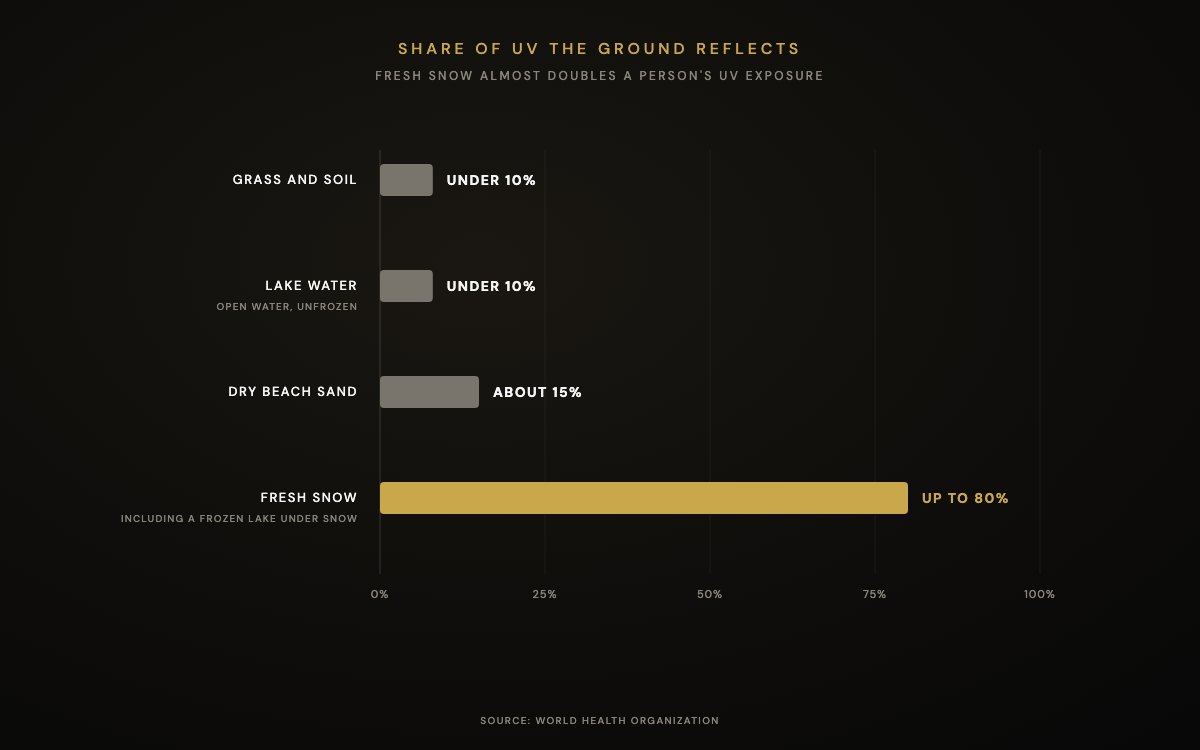
Every window looks at the sky with its top half and the ground with its bottom half. In summer the bottom half sees grass or water, which send back very little. In winter it sees a bright reflector the size of your yard, or the size of a frozen lake.
That reflected light comes from below. It travels up under the eaves, up under blinds angled against the sun, and straight into the eyes of anyone sitting down.
To be straight with you: the sky sends less UV in winter. The UV Index in January is a fraction of July's. What changes is the route the light takes into your house. It comes in lower, reaches further and arrives from the ground as well as the sky. For your floors, that route matters more than the forecast.
What it does to your floors and furniture
Sunlight fades colour, and once it is gone it does not come back. UV does the most damage, but ordinary visible light does a good share of it too, which is why a room full of winter light fades faster than people expect.
- Hardwood. Maple and pine tend to yellow. Cherry darkens. Walnut lightens. A rug left in one spot for two winters leaves its outline on the floor.
- Upholstery and rugs. The tops of sofa backs and cushions facing the window go first.
- Art, photos and cabinetry. Anything on the wall opposite south glass sits in the winter sun for hours a day.
The surprise is where it happens. Summer sun stays near the window. Winter sun reaches the far side of the room, so that is often where the worst fading turns up.
To see it in your own house, lift the corner of a rug, or move a lamp that has not moved since last winter, and compare the floor underneath.
What it does to the glass itself
The crack that starts at the edge
On a cold morning the window frame, and the strip of glass it holds, are as cold as the night was. When the sun comes up, the middle of the pane warms quickly while the edge stays cold inside the frame.
Glass grows as it warms. A warm middle pulling against a cold edge puts the edge under strain, and edges are where glass is weakest. A difference of about 27°C between the middle and the edge is enough to crack ordinary window glass. A small chip on the edge makes it crack sooner.
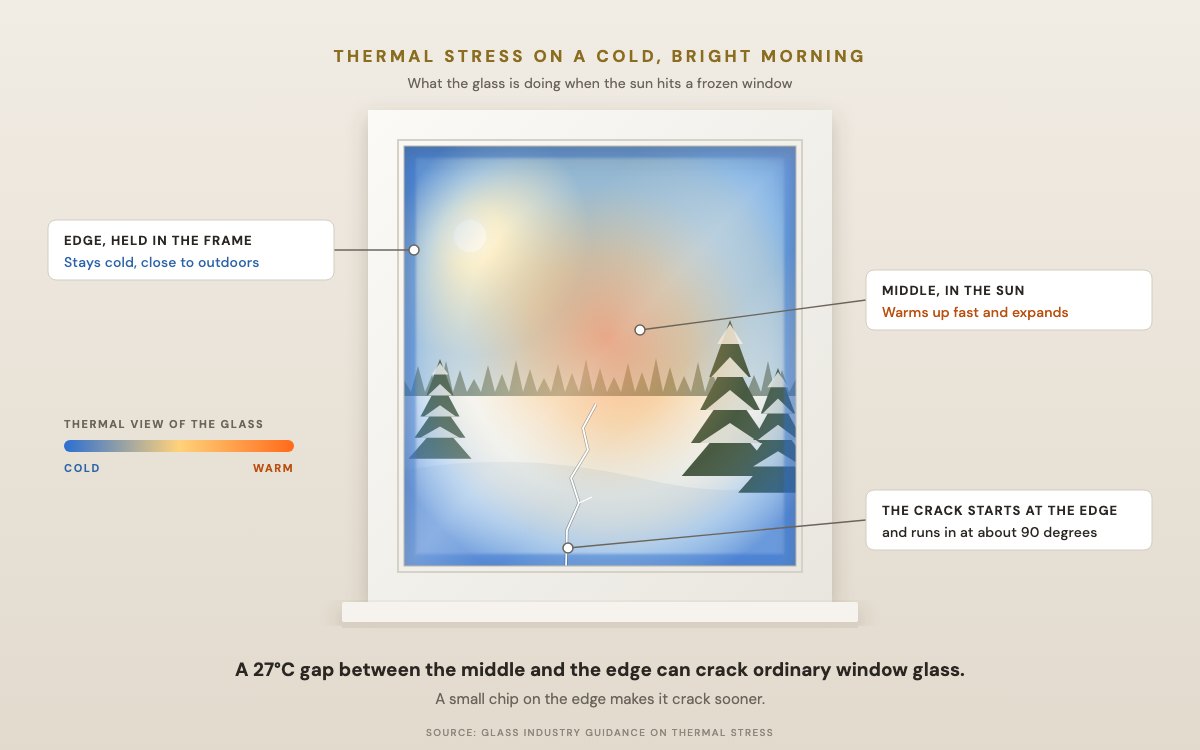
A thermal crack has a signature: it starts at the edge, runs in at close to a right angle, then wanders. If you have one like that on a sunny side of the house, it was the temperature, not a stone.
Winter makes it more likely in a few ways:
- Very cold nights leave a bigger gap between edge and middle once the sun arrives.
- Sharp shadows from snowy eaves, railings or bare trees leave cold stripes beside sunlit glass.
- Heavy drapes closed tight against the glass trap heat behind the fabric. Leave about two inches of space, with room for air at the top or bottom.
- Heat registers blowing behind closed drapes add another uneven load.
The seal that wears out
A modern window is a sealed unit: two or three panes with a sealed edge and dry gas between them. In winter the outer pane can sit at minus 20 overnight and warm well past room temperature by afternoon. Every swing makes the gas expand and shrink, and the seal flexes like a hinge. Sunlight wears on it too.
When a seal fails, moisture gets in and you see fog or haze between the panes. It cannot be wiped off, and nothing put on the surface will fix it. The unit needs replacing.
One honest note: a covering that absorbs heat makes the glass warmer. The wrong product on the wrong window adds to both of these problems. That is why we check the glass before we quote.
What it does to you
Glare is more than squinting. Bright light scatters inside the eye and washes out contrast, so you actually see less. A sunlit snowy yard is roughly 30 times brighter than a laptop screen. Look past your screen at it and your eyes spend the day adjusting between the two.
The American Optometric Association lists screen glare as a cause of digital eye strain: sore eyes, headaches, blurred vision and dry eyes. It advises that windows should not be directly visible from where you sit at a monitor. A winter sun 20 to 30 degrees up sits right in that line of sight. It gets harder with age, too, because the eye scatters more light as it gets older, with the biggest effect after 50.
Then there is your skin. The part of UV that ages skin, called UVA, passes through ordinary window glass. A well known example is a truck driver featured in the New England Journal of Medicine in 2012: after 28 years at the wheel, the side of his face by the window looked far older than the other. A favourite chair by a south window is the home version, on a smaller scale. The Skin Cancer Foundation recommends UV blocking window coverings as part of everyday sun protection.
None of this means giving up daylight. Winter days are short enough. The goal is the light without the damage.
The defences: Low-E glass and window film
Start with what you have: Low-E glass
If your windows went in after the mid nineties, they very likely have a Low-E coating: a thin, invisible metal layer inside the sealed unit that manages heat. Our guide to Low-E glass shows you how to check for it with a phone flashlight.
Low-E helps with UV, but how much depends on the type:

- Plain double pane, no coating: about 59 out of 100 get in.
- Low-E made to let winter sun in: about 49 out of 100. This is the type many Ontario homes have.
- Low-E made to block summer heat: about 16 out of 100, and as few as 6 with the strongest coatings.
- Any of these with a solar control layer added: fewer than 1.
The catch: none of these coatings do much about glare. They all let most of the visible light through, typically 70 to 80 per cent. Low-E was built to save energy, not to protect your floors or your eyes from a snowfield.
Add a solar control layer
Solar control window film is a thin, clear layer applied to the inside of the glass you already own. It works with your Low-E, not against it.
- It blocks 99 per cent of UV.
- It keeps the room bright. Our house grade keeps 68 per cent of the visible light and premium keeps 65, so the view stays clear and the hard edge comes off the snow.
- It slows fading, because it trims visible light as well as UV.
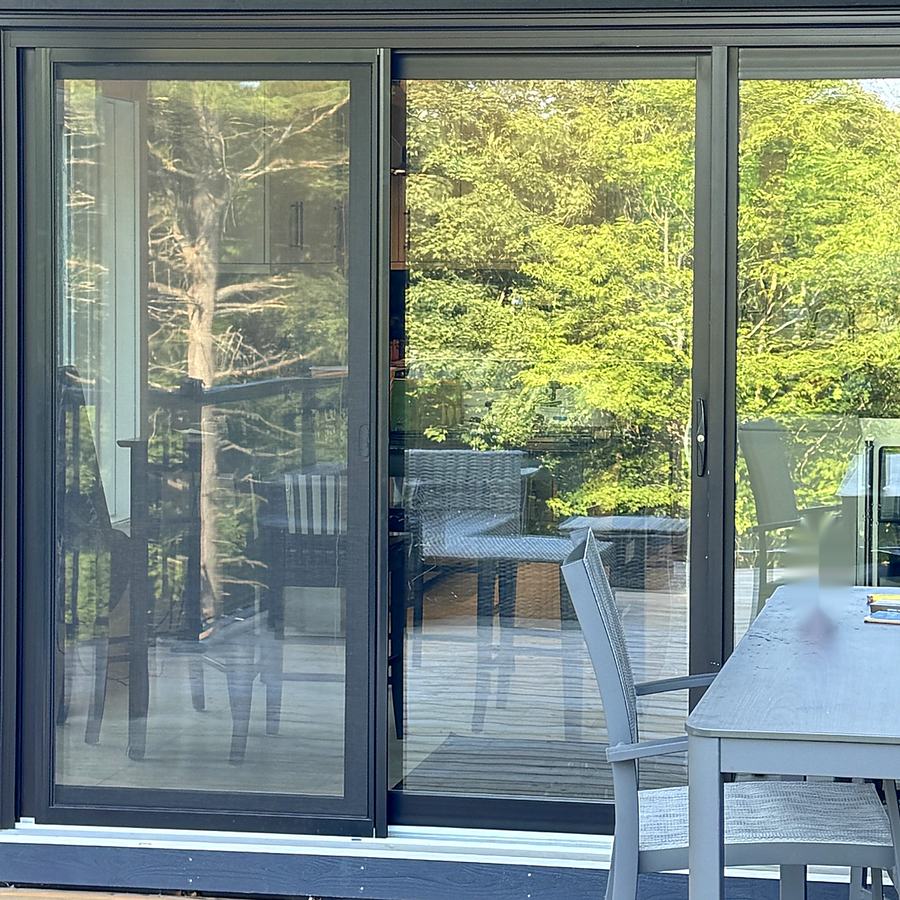
For a desk facing a snowfield, darker and more reflective layers cut more glare. They also put more heat into the glass, so they need the glass check most. Reflective layers turn into a mirror on the inside at night when your lights are on, and we tell you that before you buy.
One trade-off: solar control blocks some of the sun's warmth all year, so a room that relies on winter sun gets slightly less of it. Most people never notice.
For cold rooms: an insulating low-E layer
If a room feels cold beside the glass, there is a layer for that too. An insulating low-E layer reflects your room's heat back inside in winter, so the chair by the window stops feeling drafty. In summer it blocks solar heat, and it blocks UV like the solar control layer does.
It does the most on glass with no Low-E of its own: older double panes, cottage single glazing, and sunrooms or patio doors from before the mid nineties. On a window that already has Low-E the extra benefit is smaller, and we will tell you so.
The glass check comes first
Before we quote, we look at your glass and find out what it is: whether it has a Low-E coating, whether it is ordinary or tempered glass, how big it is, which way it faces, what shadows cross it, and whether every seal is sound.
Then we quote only products rated for that glass. If nothing suitable exists for a window, it comes off the quote. If a seal has already failed, we tell you, because that unit needs replacing and a covering would be money wasted.
Five things you can do this week
- Give your drapes room. About two inches off the glass, with air at the top or bottom, and never a heat register trapped behind them.
- Turn the desk. Put the screen side-on to the window, not facing it or backing onto it.
- Find the noon sun patch. On the next sunny day, see where the light lands at noon and move the rug or art that lives there.
- Walk every window. Look for fog between the panes and chips along the glass edges. A chipped edge on a sunny side is a crack waiting for a cold morning.
- Do the flashlight test from our Low-E guide so you know what glass you have before anyone quotes you.
Late winter is the peak
The worst of it is not December. It is late February and March, when the days are longer, the snow is deepest and the sun is still low enough to reach the back of the room. Interior work carries on all winter, so there is time to deal with it first. Our post on winter installs explains how.
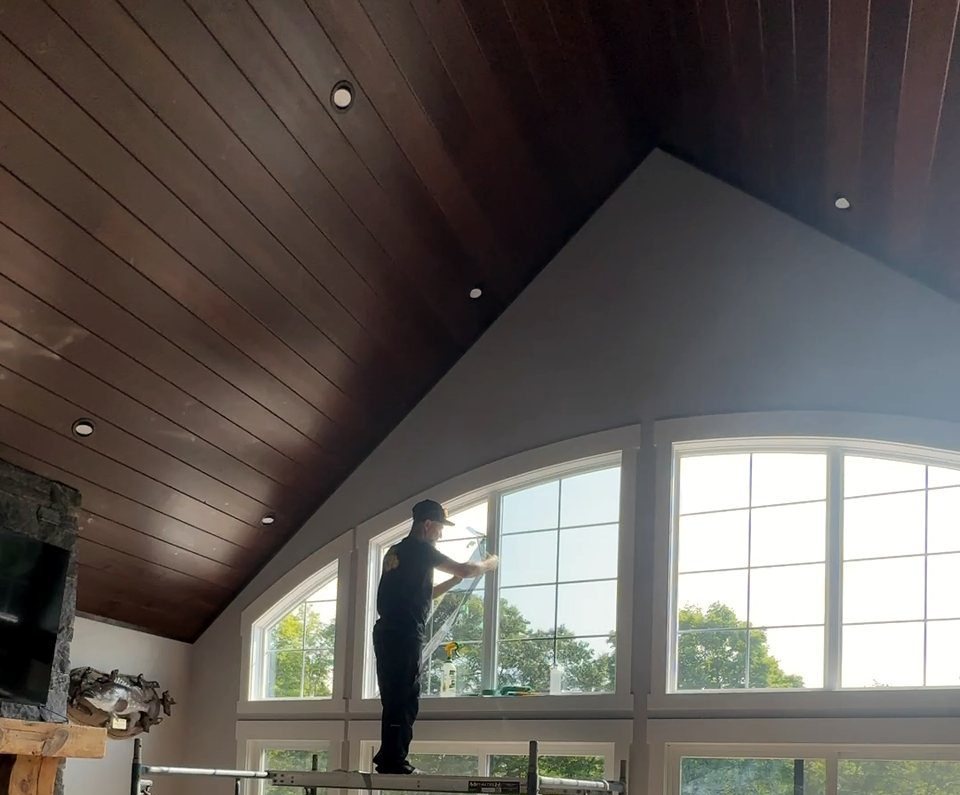
Paneless Glass Solutions fits solar control window film on existing glass across Simcoe County, Muskoka and Georgian Bay, installed by our own crew. Every job is measured on site and quoted in writing before any work starts. The easiest way to begin is the Project Builder, which walks you through measuring your windows.
Sources: World Health Organization (UV questions and answers; Global Solar UV Index guide). National Snow and Ice Data Center. Skin Cancer Foundation. American Optometric Association. New England Journal of Medicine, 2012. Glass Association of North America. Published glass manufacturer data for double pane windows. Sun angles and reach are worked out for Innisfil, 44 degrees north, on a clear day at noon.


